Automated WBGT Monitoring

Real-Time Heat Stress Monitoring for Your Job Sites. No Sensors. No Hardware.

HeatShield monitors WBGT conditions at every job site automatically, calculating actual heat stress risk based on temperature, humidity, radiant heat, workload, clothing, and acclimatization. Supervisors get instant alerts. Workers get clear guidance. Everything gets documented.

WBGT-based risk (not just heat index), updated every 30 minutes
Supervisor alerts at every threshold crossing: automatic, no manual checks
Every monitoring session logged and stored: inspection-ready records
No sensors or hardware: works on any phone, setup in 15 minutes
Start Your Free 14-Day Trial → No credit card required. Full platform access.
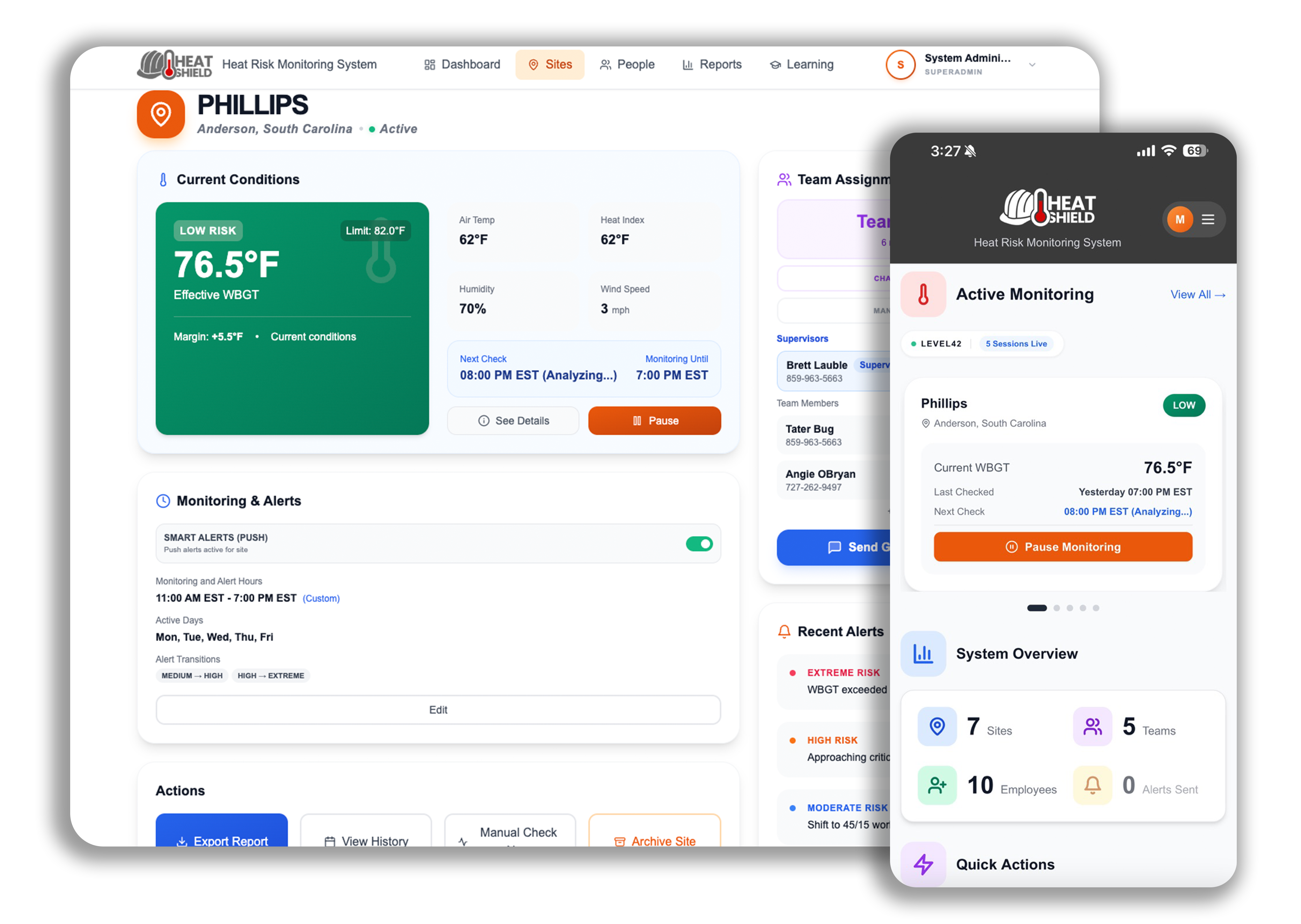
HeatShield heat stress monitoring dashboard

Heat stress monitoring software measures the actual heat load on a crew in real time using Wet Bulb Globe Temperature (WBGT), which accounts for temperature, humidity, radiant heat, workload, and clothing, not just the heat index. HeatShield calculates WBGT automatically for every job site, tightens alert thresholds for unacclimatized workers, notifies supervisors when a risk level is crossed, and logs every reading with a timestamp.

Your Phone's Weather App Is Giving Your Crew Bad Information.

The Problem

Heat Index Only Tells Part of the Story

Standard weather apps report air temperature and heat index. Heat index only accounts for temperature and humidity. It doesn't consider:

  • Radiant heat from sun exposure and surfaces
  • Workload intensity (sitting vs. shoveling vs. carrying)
  • Clothing and PPE (reflective vests, non-breathable gear)
  • Whether workers are acclimatized to the heat

A worker in full PPE doing heavy work in direct sun experiences dramatically higher heat stress than the heat index suggests. Monitoring with a weather app isn't just inadequate, it's a false sense of safety.

The HeatShield Approach

WBGT: The Standard NIOSH, ACGIH, and the Military Actually Use

HeatShield calculates WBGT and adjusts for real-world field conditions:

Factor Adjustment Range
Clothing / PPE type +0°F to +18°F WBGT
Workload intensity Rest → Very Heavy
Radiant heat exposure Accounted for in WBGT
Acclimatization status Adjusted thresholds
The result is a heat stress risk level (Low, Moderate, High, or Extreme) that reflects what your specific crew is actually experiencing, not what the weather station recorded.

Set It Up Once. It Runs Automatically.

1
Add Your Job Sites

Enter a site address or ZIP code. HeatShield geocodes it to precise coordinates and begins pulling live weather data. No per-site fees.

2
Configure Monitoring Windows

Set start time, active workdays, and check intervals to match your crew's schedule. Monitoring runs automatically, no manual activation each day.

3
Supervisors Get Instant Alerts

When conditions reach a new risk level, supervisors are notified immediately with current risk level, recommended actions, and triggering conditions.

4
Workers Get the Alert by Text

Acting on the alert, the supervisor composes and sends an SMS to the affected workers from within the platform. Workers read the current heat risk level and recommended protective measures right in the message. No app to download, no login, no link to tap.

5
Everything Gets Logged

Every condition check, risk transition, and alert delivery is timestamped and stored automatically. Export as PDF or CSV when you need documentation.

Monitoring Data Is Only Valuable If It's Documented.

Real-time monitoring tells you what conditions are right now. But when OSHA asks what conditions were on July 14th at 2:15 PM, and whether your supervisor was notified, and whether your crew had completed their training, that's where most systems fall short.

HeatShield stores everything. Every condition check, alert, and training completion is logged with a timestamp and accessible for export. Your monitoring data becomes your compliance record automatically.

  • Searchable monitoring history: conditions at every check interval, every day
  • Alert log: delivery time, content, and acknowledgment status per supervisor
  • Training records: completion status and certificates per worker
  • Compliance Packets (Pro): organized, inspection-ready documentation exports
  • 12–36 months data retention depending on plan

Real-Time Heat Risk Has To Account For Who's Acclimated and Who Isn't.

An unacclimated worker faces roughly 2× the heat illness risk of a fully acclimated one at the same WBGT. HeatShield tracks acclimatization status per worker, including the 14-day onboarding window and a reset after 4 or more consecutive missed work days, and tightens alert thresholds for anyone in the at-risk window. Federal OSHA enforcement and every major state heat rule require this kind of close observation, but almost no monitoring tool does it.

14
Days

The standard observation window for new hires and workers returning after time away from heat. HeatShield flags every worker in this period automatically.

4+
Missed Work Days

Four or more consecutive missed work days resets a worker to day zero. One to three missed days only pause progress. Missed days are counted on the site's monitoring schedule, so weekends off a Monday-to-Friday site do not count.

Higher Risk

Heat illness risk is significantly elevated during the acclimatization window. HeatShield adjusts alert thresholds for at-risk workers automatically.

👷
Per-Worker Status Tracking

Each worker's acclimatization start date is recorded. HeatShield identifies in real time who is in the at-risk observation window, with no spreadsheets required.

🌡️
Adjusted Alert Thresholds

Real-time heat stress scores factor in acclimatization status. Unacclimated workers trigger supervisor alerts at lower WBGT thresholds than fully acclimated crew members.

📋
Documented for Inspection

Acclimatization records are stored per worker and exportable as part of your compliance packet, showing inspectors exactly which workers were in observation, and when.

🔄
Automatic Reset on Return

When a worker misses 4 or more consecutive work days, HeatShield automatically resets them to day zero and re-enters them in the acclimatization window. Shorter absences of 1 to 3 days pause progress without a full reset. No manual tracking required from supervisors.

Outdoor Sites Need No Hardware. Indoor Sites Use Yours.

For outdoor crews, HeatShield pulls live weather data from your job site's exact GPS coordinates automatically, no sensors, no devices, no IT project. For indoor environments, the PRO-tier Sensor API Integration connects your existing WiFi-capable hardware directly to HeatShield for live WBGT readings. Either way, setup takes under 15 minutes.

Other Monitoring Approaches
  • Hardware purchase required before you can start
  • Per-worker wearable devices workers must carry
  • Third-party cloud relay adds latency and cost
  • Hardware maintenance, battery replacement, failures
  • Enterprise pricing, no self-serve option
HeatShield
  • Outdoor monitoring: no hardware, ever
  • Indoor monitoring: connect your own sensor via API (PRO)
  • No per-worker devices, works on any smartphone
  • No third-party cloud relay for sensor data
  • Self-serve plans starting at $39/month

Sensor API Integration PRO

HeatShield Also Monitors Indoors, With Live Hardware Data.

Outdoor WBGT monitoring pulls weather data automatically. But indoor environments (warehouses, distribution centers, commercial kitchens) have their own climate that weather data can't reflect.

The PRO-tier Sensor API Integration lets your existing WiFi-capable temperature and humidity hardware POST readings directly to HeatShield. No third-party cloud relay, no manual entry. HeatShield uses the live reading to calculate WBGT, trigger threshold alerts at 82°F and 87°F, and build the indoor compliance record your heat illness prevention program requires.

  • Works with any WiFi-capable sensor that supports custom HTTP POST endpoints
  • Per-site API key: issued, managed, and rotatable by admins
  • Live reading and staleness status shown in the HeatShield dashboard
  • Recommended: Monnit ALTA gateway + temp/humidity sensor, supports custom HTTP push out of the box
  • Feeds live data into the same WBGT calculation used for outdoor sites
Sensor API Integration: PRO
Live Reading
84.2°F / 58% RH
● Live · Updated 42 sec ago
⚠ Threshold Crossed — 82°F
Tier 1 protections required · Supervisor notified
Site API Key
hs_live_••••••••••••••••
Managed by admin · Rotatable anytime

Monitoring Proves the Conditions. Training Proves Your Crew Was Ready.

OSHA doesn't just want to see that you were watching the temperature. They want evidence that your workers knew what to do when it got dangerous.

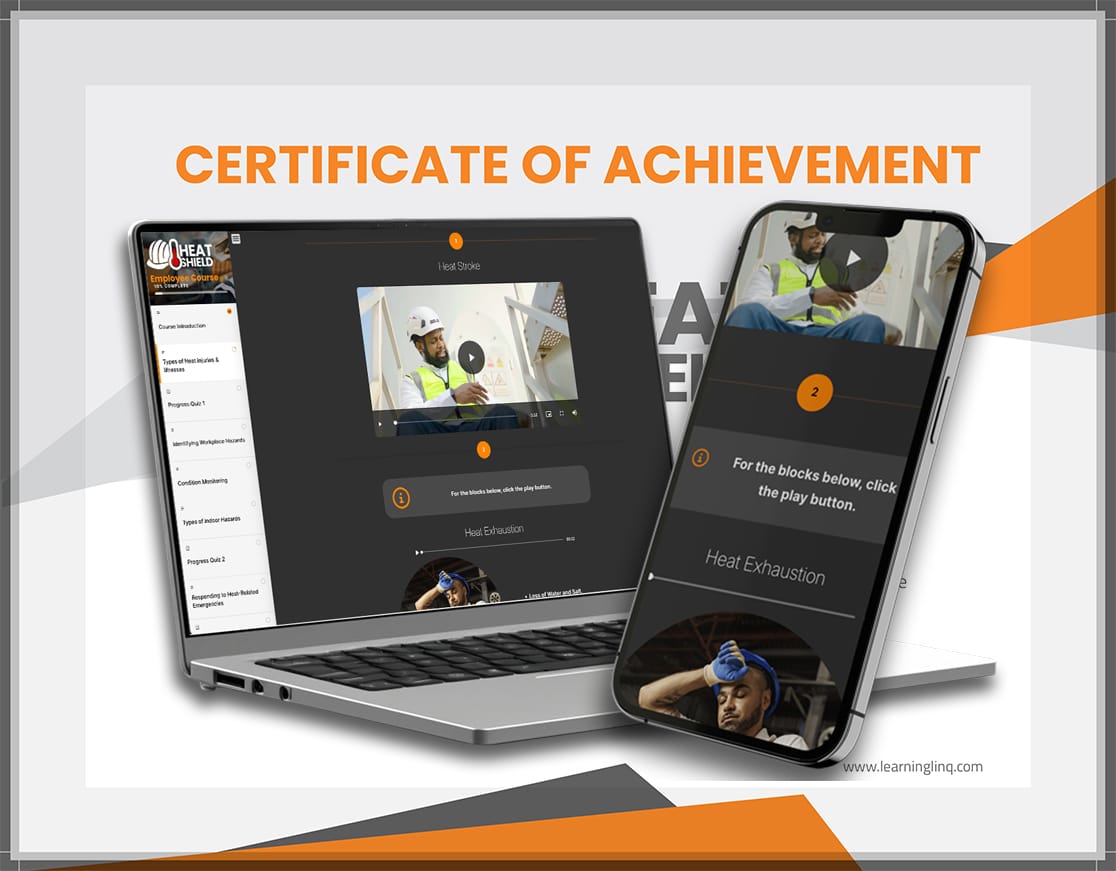
HeatShield includes a built-in, OSHA-aligned heat illness prevention training course in both English and Spanish, assigned and completed directly through the platform. Certificates of completion are stored per worker and included in your compliance records.

  • Available in English and Spanish, so every worker trains in a language they understand
  • 11-lesson course covering heat illness prevention for employees and supervisors
  • Accessible on any phone, no app download required
  • Progress tracked per worker
  • Certificates of completion stored and exportable
  • Included with every plan
HeatShield LMS training course overview

Outdoor Crews and Indoor Facilities, One Platform.

Construction

Outdoor crews exposed to direct sun, heavy workload, and PPE heat load.

Agriculture

Seasonal and field labor with high acclimatization turnover.

Landscaping

Mobile outdoor crews working multiple sites in a single day.

Warehousing and Distribution

Indoor heat in facilities without climate control.

Manufacturing

Process heat indoors year-round, not just in summer.

Commercial Kitchens

Sustained indoor heat exposure regardless of season.

Built for Real Conditions. Used by Real Crews.

★★★★★

"Perfect for my entire team. It gives me compliance peace of mind."

— Randy P.
★★★★★

"Easy to navigate and the concepts were clear and easy to understand."

— Lauren T.
★★★★★

"I loved the videos and the interactions, so much better than other trainings!"

— Justin O.

What Supervisors and Safety Managers Ask

HeatShield pulls live data from professional weather networks using the precise GPS coordinates of your job site, not the nearest city or airport station. Data is updated on your configured monitoring interval throughout the day.
Heat index only measures temperature and humidity. WBGT (Wet Bulb Globe Temperature) is a more complete measure of heat stress that accounts for radiant heat from the sun and surfaces. It's the standard used by NIOSH, ACGIH, and military heat safety programs, and it's what HeatShield uses.
Yes. All plans include unlimited job sites. You can group sites together using Site Groups to reduce alert fatigue across large operations.
When conditions cross a threshold, the supervisor gets an alert in the HeatShield app, then composes and sends an SMS to the affected workers from within the platform. Workers receive a plain text message from a recognized number with the current risk level and recommended protective actions like rest, shade, and hydration. There is no app to download and no link to tap.
HeatShield's monitoring thresholds and documentation structure are aligned with state-specific requirements for California, Oregon, Washington, Colorado, and Minnesota. For operations spanning multiple states, the system applies the appropriate framework per site location. States with worker notice of rights are also integrated into the learning platform and saved to the reporting section in the application.
Both. For outdoor sites, HeatShield pulls live weather data automatically from the GPS coordinates of each job site, no hardware needed. For indoor sites like warehouses, distribution centers, and manufacturing floors, the PRO-tier Sensor API Integration lets you connect physical temperature and humidity hardware that POSTs live readings directly to HeatShield. Each site is configured independently as outdoor or indoor, so mixed operations run from a single account. Without the Sensor API, indoor sites still have full threshold documentation and compliance recordkeeping, just without automated live sensor readings.
The Sensor API Integration is a PRO feature that connects physical temperature and humidity hardware to HeatShield for indoor site monitoring. Your sensor POSTs live readings to HeatShield's endpoint using a per-site API key. HeatShield then calculates WBGT and fires 82°F/87°F threshold alerts in real time. We recommend the Monnit ALTA gateway + temperature/humidity sensor, which supports custom HTTP push with custom headers out of the box. Any WiFi-capable sensor that can POST to a custom HTTP endpoint will work.
PRICING

Everything You Need to Monitor. Everything You Need to Document.

No per-site fees. No hardware. No per-worker charges for monitoring.

Core

Automated monitoring for field operations

$ 39 /mo

Billed $468 annually

  • Unlimited job sites
  • Automated WBGT monitoring & risk transitions
  • Supervisor notifications & escalation
  • Per-worker acclimatization tracking
  • Configurable monitoring windows
  • Site Groups
  • 12-month data retention
  • PDF export
  • 10 training seats included*
  • Standard support
  • * $10/seat for additional users

Start with 14-Day Free Trial

No credit card required

Pro

Extended Records, Reporting, Training & Indoor Sensor API

$ 59 /mo

Billed $708 annually

  • Everything in Core, plus:
  • Compliance Packet Downloads
  • Jobsite Templates
  • Sensor API Integration Indoor
  • Incident Reporting
  • Extended data retention (36 months)
  • PDF + CSV exports
  • 20 training seats included*
  • Priority support
  • * $5/seat for additional users

Start with 14-Day Free Trial

No credit card required

Stop Guessing. Start Monitoring With Numbers That Hold Up.

No hardware. No app downloads. Setup in 15 minutes.

Regulatory Sources