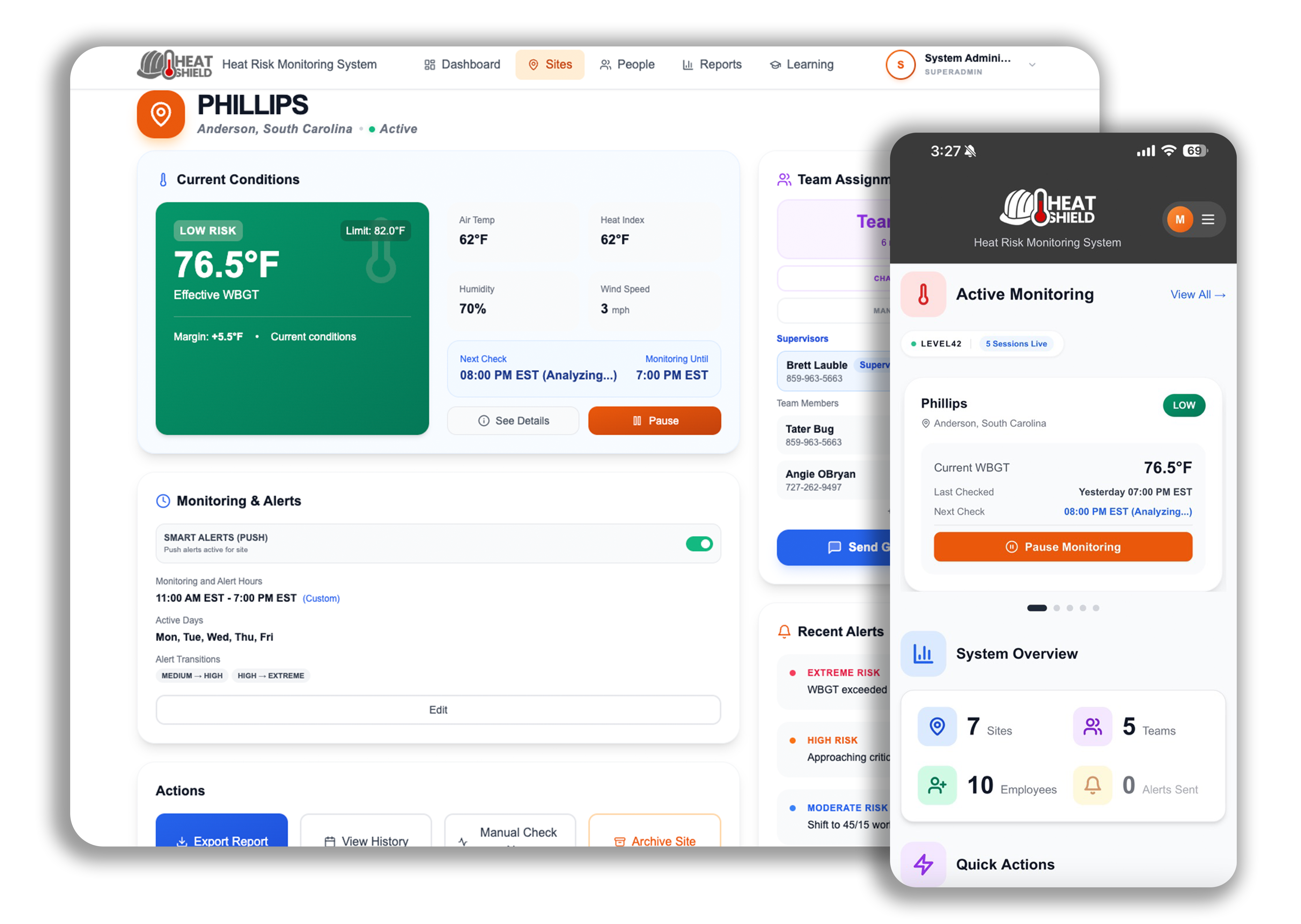
Minnesota's indoor heat stress regulation under Minn. R. 5205.0110 sets WBGT-based exposure limits for warehouses, manufacturing, food processing, and any indoor workplace where heat is a hazard. HeatShield handles the monitoring, acclimatization tracking, documentation, and training that MNOSHA requires, with live sensor data for accurate indoor WBGT calculation. Outdoor crews are covered too via OSHA's General Duty Clause.
Minnesota's heat stress standard is an indoor regulation enforced by MNOSHA under the state's OSHA-approved plan. It uses Wet Bulb Globe Temperature (WBGT) as the measurement standard and sets two-hour time-weighted exposure limits based on work intensity. Key requirements:
Minn. R. 5205.0110 covers indoor workplaces. But Minnesota employers with outdoor crews (construction, landscaping, agriculture, municipalities) face the same enforcement risk as employers in states with explicit outdoor standards. OSHA's General Duty Clause requires all employers to protect workers from recognized hazards, and heat is a recognized hazard. MNOSHA enforces this actively. Key outdoor requirements:
Plain-language overview only. Not legal advice. Consult qualified legal counsel for program-specific guidance.
| MNOSHA Requirement | Regulation | How HeatShield Handles It | Documentation Produced |
|---|---|---|---|
| WBGT-based indoor heat monitoring | Minn. R. 5205.0110 | PRO Sensor API Integration connects physical hardware for live indoor readings; HeatShield calculates WBGT in real time using temperature, humidity, radiant heat, and air movement | Timestamped WBGT monitoring log per site |
| Exposure limit thresholds by work intensity | Minn. R. 5205.0110 | Configurable thresholds per site based on workload type; alerts fire when exposure limits are approached or crossed | Threshold crossing log with conditions and timestamps |
| Acclimatization monitoring | Both | Per-worker acclimatization status tracked from first day; risk thresholds adjusted for workers in observation window | Worker acclimatization records per site |
| Supervisor & worker training | Both | Built-in LMS with heat illness prevention course; bilingual (EN/ES) | Certificates of completion per employee |
| Outdoor monitoring (General Duty) | Gen. Duty | Automated outdoor monitoring pulls live weather data; configurable thresholds per outdoor site; acclimatization tracking applies equally | Outdoor monitoring log with timestamped threshold events |
| Written Heat Illness Prevention Program | Both | Auto-generated compliance documentation for your org and every site | Export-ready PDF for inspection |
| Emergency response plan access | Both | Response steps surfaced during high-heat events; logged per monitoring session | Emergency procedure acknowledgment log |
MNOSHA specifically calls out acclimatization as one of the two most important methods of preventing heat disorders, alongside hydration. Minnesota's highly variable climate, where daily high temperatures can swing 30°F from one day to the next, means workers often cannot become and stay acclimatized the way workers in consistently hot climates can. That makes per-worker tracking essential, not optional.
Minnesota summer temperatures can vary 30°F from day to day, preventing workers from staying acclimatized the way they would in consistently hot climates.
Workers returning after 5 or more days away from heat exposure must restart the acclimatization observation period, even experienced workers.
Heat illness risk is significantly elevated during the acclimatization window. HeatShield adjusts alert thresholds for at-risk workers automatically.
Each worker's acclimatization start date is recorded. HeatShield automatically identifies who is in the at-risk observation window at any given time, with no spreadsheets required.
Heat stress risk scores factor in acclimatization status. Workers in the observation window trigger supervisor alerts at lower thresholds than fully acclimated crew members.
Acclimatization records are stored per worker and exportable as part of your compliance packet, showing MNOSHA exactly which workers were in observation, and when.
When a worker returns after 5+ days away, HeatShield automatically flags them as re-entering the acclimatization window, with no manual tracking required from supervisors.
WBGT is not a number your weather app provides. For indoor sites, accurate WBGT calculation requires actual temperature and humidity readings from inside the facility, not outdoor weather station estimates. That's what the PRO-tier Sensor API Integration delivers: your physical hardware POSTs live readings directly to HeatShield, which uses them to calculate WBGT and determine threshold status in real time.
Admins manage and rotate API keys per site from within the dashboard. The staleness indicator shows when a reading was last received, so you always know the data is fresh.
Warehouse distribution centers, fulfillment operations, and logistics facilities. Indoor heat stress in large warehouse spaces is a year-round issue, not just a summer problem. HeatShield monitors WBGT per site using live sensor data, tracks acclimatization for new and returning workers, and keeps your MNOSHA documentation inspection-ready.
Manufacturing plants, meatpacking facilities, commercial kitchens, and food processing operations. These environments generate significant radiant heat from machinery and cooking equipment, creating conditions where WBGT diverges substantially from simple thermometer readings. HeatShield's WBGT calculation accounts for radiant heat, giving you an accurate picture of actual worker heat stress.
Outdoor crews in construction, landscaping, and municipal operations. Minnesota's variable summer climate, with temperature swings of 30°F or more from day to day, means outdoor workers frequently face heat conditions before they're acclimatized. HeatShield tracks outdoor conditions automatically and flags acclimatization risk per worker, keeping you defensible under the General Duty Clause.
Farms, processing facilities, greenhouses, and field operations. Outdoor agricultural workers face real heat stress risk during Minnesota summers, and MNOSHA's General Duty Clause enforcement applies regardless of whether a state outdoor heat standard is codified. HeatShield automates monitoring and produces the documentation your program requires.
Date, time, site, WBGT reading, and risk level, logged automatically for every check-in, indoor and outdoor
Recipient, channel (SMS/push), delivery status, and triggering condition, documented at the moment it's sent
WBGT exposure limit events are timestamped and tied to a specific site, workload type, and monitoring record
Who was in the observation window, when it started, and how risk alerts were adjusted for at-risk workers
Employee name, course, completion date, and certificate of completion, stored per worker, exportable on demand
One-click PDF covering your full monitoring, alert, acclimatization, and training history, formatted for MNOSHA inspection
MNOSHA inspectors want to see your records on demand. HeatShield builds them in the background automatically.
MNOSHA doesn't just want to see that you were watching the temperature. They want evidence that your workers knew what to do when it got dangerous.
HeatShield includes a built-in, OSHA-aligned heat illness prevention training course — assigned and completed directly through the platform. Certificates of completion are stored per worker and included in your compliance records.
Annual billing with a 7-day free trial. No charge today.
Structured monitoring for small crews
Billed $468 annually
Start with 7-Day Free Trial
No charge today (credit card required)
Extended Records, Reporting, Training & Indoor Sensor API
Billed $708 annually
Start with 7-Day Free Trial
No charge today (credit card required)
| Feature | Core | Pro |
|---|---|---|
| Monitoring & Operations | ||
| Unlimited jobsites | ✓ | ✓ |
| Automated heat monitoring | ✓ | ✓ |
| Incident Report Logs | — | ✓ |
| Sensor API Integration (live indoor hardware data) | — | ✓ |
| Configurable monitoring windows | ✓ | ✓ |
| Dynamic risk transitions | ✓ | ✓ |
| Supervisor notifications | ✓ | ✓ |
| Team & crew management | ✓ | ✓ |
| Job templates | — | ✓ |
| Site Groups | ✓ | ✓ |
| Mobile-first PWA | ✓ | ✓ |
| Data & Reporting | ||
| Data retention | 12 months | 36 months |
| PDF export | ✓ | ✓ |
| CSV export | — | ✓ |
| Compliance Packet Downloads | — | ✓ |
| Training & Support | ||
| Integrated training access | ✓ | ✓ |
| Training seats included | 10 | 20 |
| Certificate storage | ✓ | ✓ |
| Support level | Standard | Priority |
No charge today. Full platform access. Setup in 15 minutes.