WASHINGTON · WAC 296-62-095

Washington Has One of the Most Detailed Heat Illness Prevention Rules in the West. HeatShield Is Built Around It.

From outdoor crews working under the 89°F threshold to high-heat procedures at 100°F, HeatShield handles the monitoring, acclimatization tracking, documentation, and training that Washington L&I requires. For indoor facilities, PRO users can connect physical temperature sensors directly to HeatShield for live, hardware-accurate readings.

Aligned with WAC 296-62-095, Washington's outdoor heat illness prevention standard
Per-worker acclimatization tracking (automated, no hardware required)
PRO: Connect physical sensors for live indoor WBGT data (Sensor API Integration)
Documented training with certificates of completion
Weekly supervisor review, logged as a tamper-evident compliance record
Start Your Free 7-Day Trial → Try free for 7 days. Only pay if you stay.
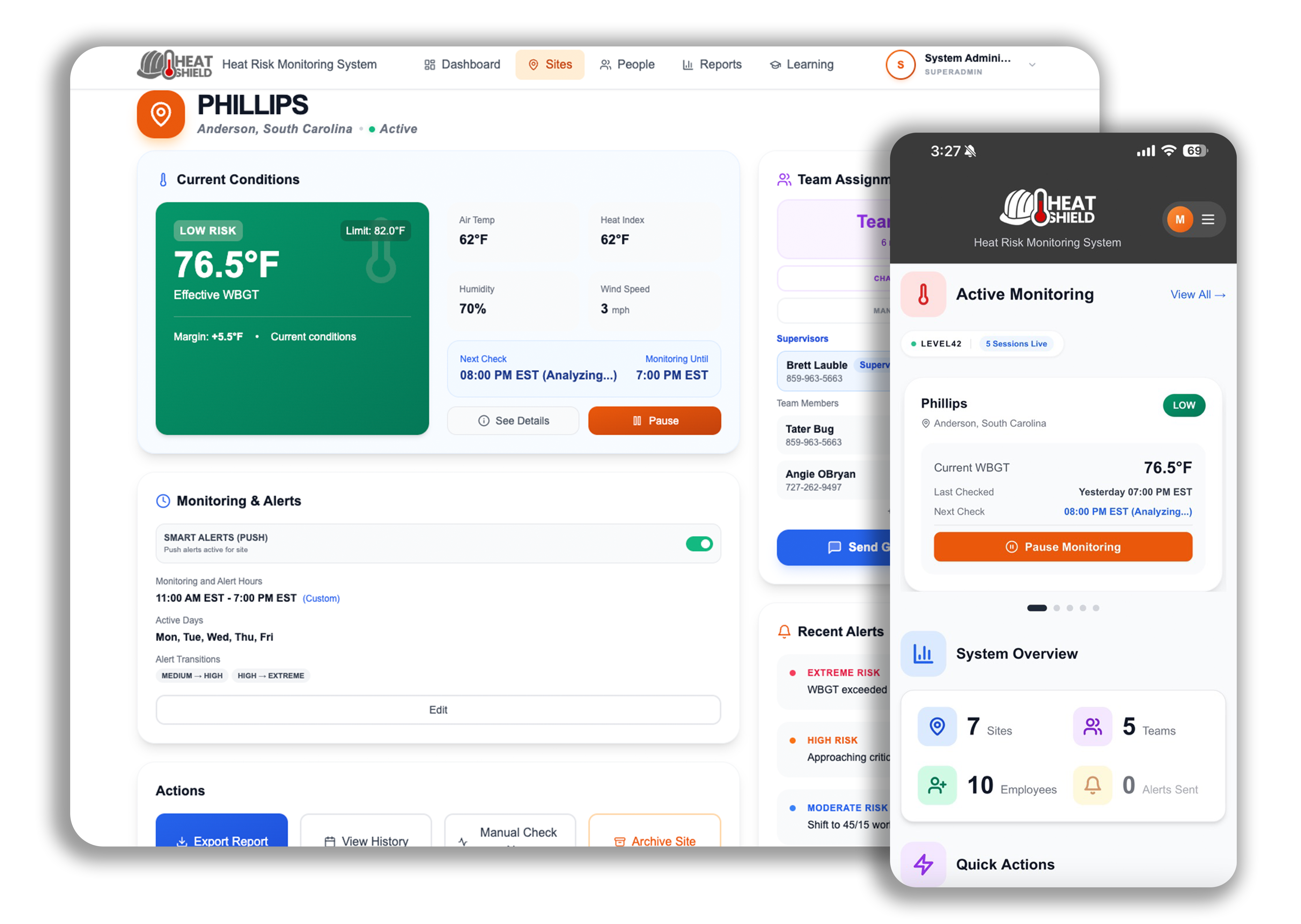
HeatShield app dashboard

One Regulation. Clear Thresholds. Actively Enforced.

WAC 296-62-095: Outdoor Heat Illness Prevention

Applies to All Outdoor Places of Employment

Washington's outdoor heat illness prevention standard covers all outdoor workers across agriculture, construction, landscaping, and other industries. Key requirements:

  • Written Heat Illness Prevention Plan: must be site-specific, maintained on-site, and available to workers and L&I inspectors on request
  • Water and shade: cool, clean drinking water accessible at all times; shade required when temperatures reach 89°F
  • High-heat procedures: at 100°F+, mandatory preventive cool-down rest periods with documented supervisor observation and check-ins
  • Acclimatization plan: new and returning workers must follow a documented acclimatization schedule during their initial exposure period
  • Training: documented training for all employees before working in heat conditions; supervisor training on recognition and emergency response
  • Emergency response procedures: written plan communicated to all workers; first aid procedures established before work begins
OSHA General Duty Clause: Indoor Workplaces

Indoor Facilities Are Covered Too, Even Without a State Indoor Standard

WAC 296-62-095 covers outdoor workers. But Washington employers with indoor facilities (warehouses, distribution centers, manufacturing plants, commercial kitchens) are not exempt from heat illness liability. OSHA's General Duty Clause requires all employers to protect workers from recognized hazards, and heat is a recognized hazard. An indoor worker who suffers heat stroke in a facility with no monitoring program creates significant liability. Key indoor requirements:

  • Heat monitoring: indoor temperature and conditions must be tracked when heat exposure is a recognized hazard
  • Water and rest: cool drinking water and rest breaks must be provided based on heat conditions and workload
  • Acclimatization: indoor workers new to heat exposure require documented acclimatization management
  • Written program: a documented heat illness prevention program for indoor facilities is expected under enforcement
  • Training: supervisors and indoor workers must be trained to recognize heat illness symptoms and emergency response
PRO: Live indoor sensor data via Sensor API Integration

Plain-language overview only. Not legal advice. Consult qualified legal counsel for program-specific guidance.

Every Washington L&I Requirement. Mapped to a HeatShield Feature.

Washington Requirement Regulation How HeatShield Handles It Documentation Produced
Water & shade access at 89°F WAC 296-62-095 Automated supervisor alert fires at exactly 89°F (the Washington threshold) with timestamped documentation Timestamped alert log per site
High-heat procedures at 100°F WAC 296-62-095 Automatic high-heat alert fires at exactly 100°F with push notification and alert email to supervisor, plus high-heat procedure checklist High-heat activation log with conditions
Acclimatization monitoring Both Per-worker acclimatization status tracked; risk thresholds adjusted for workers in observation window Worker acclimatization records per site
Supervisor & worker training Both Built-in LMS with heat illness prevention course; bilingual (EN/ES) Certificates of completion per employee
Indoor monitoring (General Duty) Gen. Duty PRO Sensor API Integration connects physical hardware for live indoor readings; configurable thresholds per indoor site Indoor monitoring log with timestamped threshold events
Written Heat Illness Prevention Plan Both Auto-generated compliance documentation for your org and every site Export-ready PDF for inspection
Emergency response plan access Both Response steps surfaced during high-heat events; logged per monitoring session Emergency procedure acknowledgment log

The Requirement Most Washington Employers Don't Track Per Worker.

WAC 296-62-095 requires close observation of workers during their initial period working in heat, and for workers returning after time away from heat work. Most companies don't track this at all. HeatShield does it automatically, per worker, on every site.

14
Days

Washington requires close supervisor observation during a worker's initial heat exposure period. New hires and returning workers both qualify.

5+
Days Off

Workers returning after 5 or more days away from heat exposure must restart the acclimatization observation period.

Higher Risk

Heat illness risk is significantly elevated during the acclimatization window. HeatShield adjusts alert thresholds for at-risk workers automatically.

👷
Per-Worker Status Tracking

Each worker's acclimatization start date is recorded. HeatShield automatically identifies who is in the at-risk observation window at any given time, with no spreadsheets required.

🌡️
Adjusted Risk Thresholds

Heat stress risk scores factor in acclimatization status. Workers in the observation window trigger supervisor alerts at lower thresholds than fully acclimated crew members.

📋
Documented for Inspection

Acclimatization records are stored per worker and exportable as part of your compliance packet, showing Washington L&I exactly which workers were in observation, and when.

🔄
Automatic Reset on Return

When a worker returns after 5+ days away, HeatShield automatically flags them as re-entering the acclimatization window, with no manual tracking required from supervisors.

If Your Washington Workers Are in the Heat, Outdoor or Indoor, You Have a Compliance Obligation.

🏗️

Construction

General contractors, subcontractors, and specialty trades working outdoor sites across Washington. WAC 296-62-095 applies to every crew on every active site, and L&I enforces it aggressively. HeatShield monitors each jobsite individually, tracks acclimatization for new hires and returning workers, and keeps your documentation inspection-ready.

🌾

Agriculture

Farms, orchards, hop yards, and packing operations. Washington L&I's heat enforcement program is active across agricultural operations statewide. Your records need to be airtight. HeatShield automates monitoring across multiple field sites, tracks crew acclimatization status, delivers bilingual (EN/ES) training, and produces the documentation your HIPP requires.

🌿

Landscaping & Municipalities

Maintenance crews, installation teams, parks departments, and public works operations running across dozens of locations in high-heat conditions. HeatShield scales to unlimited sites at no extra cost and tracks acclimatization for seasonal workers who rotate in and out throughout the year.

🏭

Warehousing & Indoor Facilities

Distribution centers, warehouses, manufacturing plants, and commercial kitchens. WAC 296-62-095 doesn't cover indoor workers. OSHA's General Duty Clause does. HeatShield's PRO Sensor API Integration connects physical temperature and humidity hardware directly to your account, delivering the live WBGT data your indoor compliance program requires.

Live Hardware Data for Indoor Washington Facilities (No Cloud Middleman)

Outdoor monitoring pulls weather data automatically. Indoor monitoring needs real temperature and humidity readings from inside the building. With Sensor API Integration, your existing WiFi-capable hardware POSTs readings directly to HeatShield, with no third-party cloud relay or manual data entry.

HeatShield uses the live sensor reading to calculate WBGT and determine threshold status in real time. Admins manage and rotate API keys per site from within the dashboard. The staleness indicator shows when a reading was last received, so you always know the data is fresh.

  • Works with any WiFi-capable sensor that supports custom HTTP POST endpoints
  • Per-site API key, issued, managed, and rotatable by admins
  • Live reading and staleness status displayed in the HeatShield UI
  • Recommended: Monnit ALTA gateway + temp/humidity sensor, which supports custom HTTP push out of the box
  • Feeds live data into WBGT calculation, with no static indoor temp assumptions
Indoor Threshold Monitoring: General Duty Compliance
89°F
Outdoor Tier 1: Protective Measures Required
Water, shade & acclimatization monitoring activated Supervisor alert with timestamp
100°F
Outdoor Tier 2: High-Heat Procedures Required
Rest periods & direct supervisor observation Supervisor sends SMS alerts to workers from the platform
Thresholds applied automatically for Washington sites. Indoor sites configurable per facility.

What Gets Documented. Automatically. Every Day.

📋
Every monitoring event

Date, time, site, temperature, heat index, WBGT score, and risk level, logged automatically for every check-in

🔔
Every alert sent

Recipient, delivery channel, delivery status, and triggering condition, documented at the moment it's sent

🌡️
Every threshold crossed

89°F and 100°F: each event timestamped and tied to a specific site and monitoring record

👷
Worker acclimatization status

Who was in the observation window, when it started, and how risk alerts were adjusted for at-risk workers

🎓
Training completions

Employee name, course, completion date, and certificate of completion, stored per worker, exportable on demand

📄
Compliance packet export

One-click PDF covering your full monitoring, alert, acclimatization, and training history, formatted for Washington L&I inspection

Washington L&I inspectors want to see your records on demand. HeatShield builds them in the background automatically.

What Washington Employers Ask Before Starting a Trial

Yes. HeatShield is configured to Washington's WAC 296-62-095 thresholds: 89°F for water, shade, and initial protective measures, and 100°F for high-heat procedures. When you set up a Washington site, these thresholds are applied automatically. No manual configuration required.
Acclimatization is the physical process by which a worker's body adapts to working in heat. Washington L&I requires that new employees and workers returning after time away from heat be closely observed during their initial heat exposure period. HeatShield tracks each worker's acclimatization start date, automatically identifies who is currently in the at-risk window, adjusts alert thresholds for those workers, and produces acclimatization records for your compliance packet. No manual tracking required.
Inspectors typically ask for: (1) your written Heat Illness Prevention Plan, (2) evidence that supervisors and workers were trained before heat season, (3) monitoring logs showing conditions were tracked at each site, (4) documentation that high-heat procedures were activated at the correct thresholds, and (5) acclimatization records for new and returning workers. HeatShield produces all of this automatically and stores it in an exportable compliance packet.
No. WAC 296-62-095 covers outdoor workers only. However, Washington employers with indoor facilities are covered by OSHA's General Duty Clause, which requires all employers to protect workers from recognized hazards. Heat is a recognized hazard. HeatShield's PRO Sensor API Integration provides live indoor WBGT monitoring for warehouses, distribution centers, manufacturing plants, and other indoor facilities.
Yes. HeatShield supports unlimited job sites on every plan at no extra cost per site. Each site gets its own monitoring schedule, its own alert history, and its own compliance documentation, all accessible from a single account. Outdoor and indoor sites can be mixed freely.
No app install required. HeatShield is a Progressive Web App that works in any mobile browser. Workers receive an Organization Code to log in to the Training Portal. No IT setup required.
The Sensor API Integration is a PRO-tier feature that lets you connect physical temperature and humidity hardware directly to HeatShield. Your sensor hardware POSTs live readings to HeatShield's endpoint using a per-site API key, with no third-party cloud relay required. We recommend the Monnit ALTA gateway + temperature/humidity sensor. If your indoor site doesn't use the Sensor API, the compliance framework, threshold documentation, and acclimatization tracking are still fully functional. You just won't have live automated sensor readings feeding the WBGT calculation.

Monitoring Proves the Conditions. Training Proves Your Crew Was Ready.

Washington L&I doesn't just want to see that you were watching the temperature. They want evidence that your workers knew what to do when it got dangerous.

HeatShield includes a built-in, OSHA-aligned heat illness prevention training course — assigned and completed directly through the platform. Certificates of completion are stored per worker and included in your compliance records.

  • 11-lesson course covering heat illness prevention for employees and supervisors
  • Accessible on any phone — no app download required
  • Progress tracked per worker
  • Certificates of completion stored and exportable
  • Included with every plan
HeatShield LMS training course overview

What our users say about HeatShield Training

★★★★★

"HeatShield is easy to navigate and the concepts were clear and easy to understand."

Lauren T
★★★★★

"I loved the videos and the interactions...so much better than other trainings!"

Justin O
★★★★★

"Perfect for my entire team. It gives me compliance peace of mind."

Randy P
PRICING

Plans built for field operations

Annual billing with a 7-day free trial. No charge today.

Core

Structured monitoring for small crews

$ 39 /mo

Billed $468 annually

  • Unlimited jobsites & monitoring
  • Automated heat monitoring & risk transitions
  • Supervisor notifications & escalation
  • Crew management
  • Mobile-first PWA experience
  • Site Groups
  • 12-month data retention
  • Standard PDF export
  • 10 training seats included*
  • Standard support
  • * $10/seat for additional users

Start with 7-Day Free Trial

No charge today (credit card required)

Pro

Extended Records, Reporting, Training & Indoor Sensor API

$ 59 /mo

Billed $708 annually

  • Everything in Core, plus:
  • Compliance Packet Downloads
  • Jobsite Templates
  • Sensor API Integration Indoor
  • Incident Reporting
  • Extended data retention (36 months)
  • PDF + CSV exports
  • 20 training seats included*
  • Priority support
  • * $5/seat for additional users

Start with 7-Day Free Trial

No charge today (credit card required)

Washington's Heat Rule Has Clear Thresholds and Active Enforcement. HeatShield Handles Both.

No charge today. Full platform access. Setup in 15 minutes.